Home / Work

Areas of focus

What the
office asks for.

A posting is a title until you set out what it obliges. These four domains describe the duties carried by the offices on the record — written as an account of the work itself, with no achievement attributed that the public record does not support.

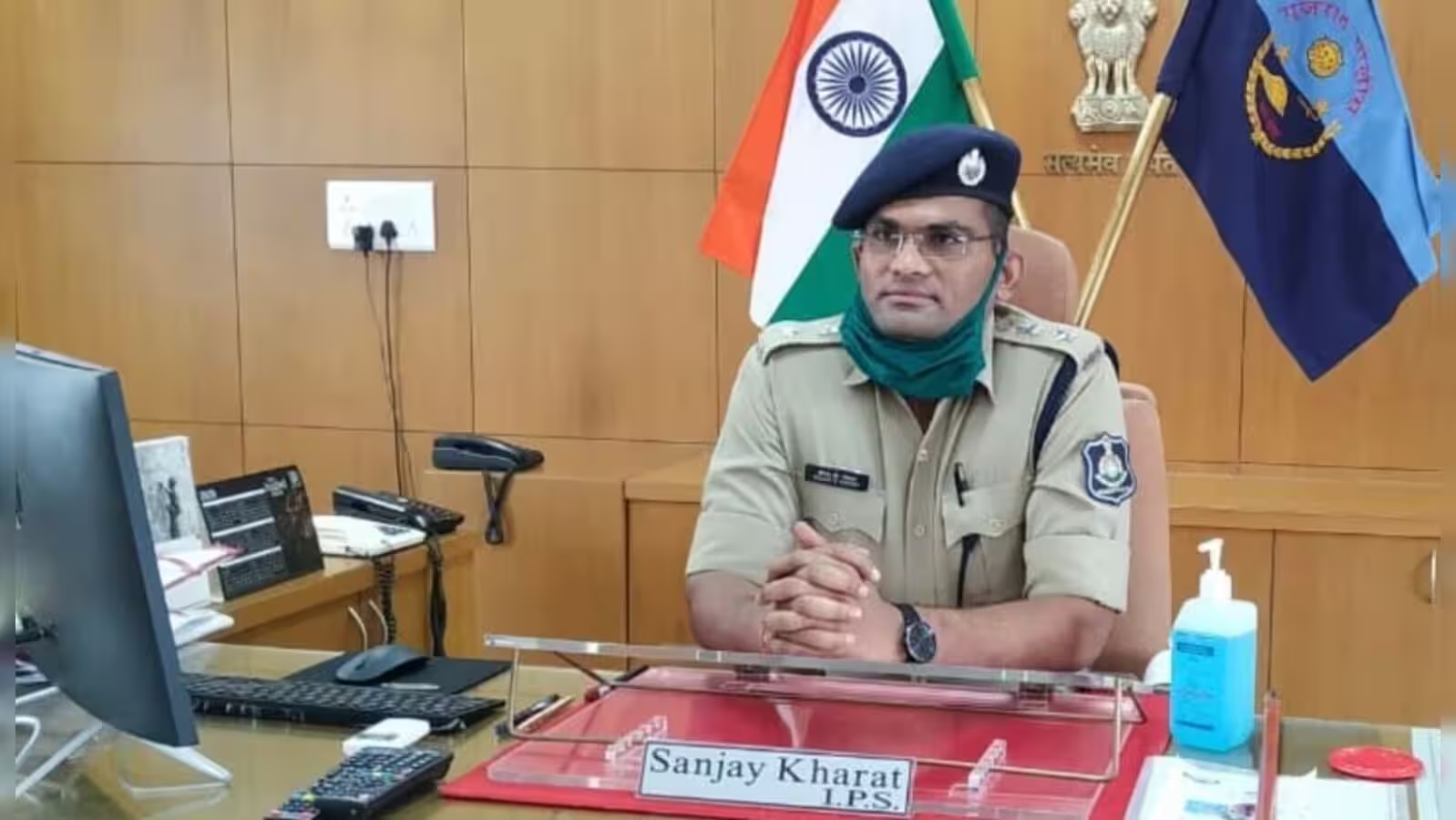
Sanjay Kharat seated at the Superintendent of Police desk, with the national flag and departmental standards behind him and the desk nameplate reading Sanjay Kharat, I.P.S.
01

The Superintendent's room: the national flag, departmental standards, and the desk nameplate reading Sanjay Kharat, I.P.S. — where a district's decisions are signed.

Domains of work

District command

Holding the whole of a district

A Superintendent of Police does not run a department. He runs a jurisdiction — and everything inside it reports upward to one desk.

The charge covers law and order, crime and investigation, every police station and outpost in the district, the armed reserve, recruitment, welfare, internal discipline and the district's standing obligation to answer its own citizens. On a given day the same officer may be reviewing a murder investigation, approving a deployment for a festival procession, and deciding a departmental complaint against a constable.

What distinguishes district command is that none of these can be delegated away entirely. The supervision of an investigation is the SP's supervision. A posting made badly is the SP's posting.

  • Law and order across the district
  • Supervision of crime and investigation
  • Police stations, outposts and the armed reserve
  • Recruitment, welfare and internal discipline
  • Public grievance and complaint redressal

Held at Aravalli (Modasa) and, since December 2024, at Amreli.

Traffic administration

The branch the public actually meets

Most citizens will never report a crime. Almost all of them will meet the traffic police.

As Deputy Commissioner of Police, Traffic, in Ahmedabad City from 2018, the portfolio was the daily circulation of one of India's largest urban jurisdictions: junctions and signal timing, enforcement policy, licensing, accident investigation, and the management of processions, festivals and public events.

It is also the branch where policing is least able to hide. A signal that fails, an enforcement drive that feels arbitrary, a junction that floods every monsoon — these are experienced by hundreds of thousands of people at once, and they are remembered.

  • Junction management and signal operation
  • Enforcement policy and road discipline
  • Licensing and regulatory functions
  • Road accident response and investigation
  • Event, festival and procession management

Held at Ahmedabad City from July 2018, on promotion to the Senior Time Scale.

Economic offences

Cases that are read, not chased

Financial crime leaves no scene. It leaves a paper trail, and the trail has to be followed correctly the first time.

The Anti-Economic Offences Wing of the CID (Crime) exists because these matters cannot be worked the way an ordinary case is worked. The evidence is documentary and digital: bank statements, company filings, ledgers, contracts, device records. The victims are often numerous and scattered across jurisdictions. The investigation is measured in years, and it will be tested by defence counsel who have had all of those years to read the same documents.

The discipline this demands is procedural above all. A seizure made without the correct authority, or a record obtained without the correct sanction, does not merely weaken a case — it removes it.

  • Investigation of large-scale financial fraud
  • Documentary, banking and digital evidence
  • Multi-jurisdictional case coordination
  • Procedural rigour in seizure and sanction
  • Long-cycle case supervision

Held as SP, Anti-Economic Offences Wing, CID (Crime), Gandhinagar — July 2023 to December 2024.

The public account

Explaining a decision on the record

The photographic record of this career shows one act more than any other: an officer at a desk, on camera, accounting for something.

Briefings and broadcast interviews are not a distraction from police work; in a district they are part of how the work is completed. A decision explained is a decision that can be scrutinised, and a police force that declines to explain itself trains the public to assume the worst.

This is also the discipline that most easily goes wrong — through saying too much before a case is ready, or too little for too long. Doing it well is a professional skill, not a matter of temperament.

  • Press briefings from the district office
  • Broadcast and recorded interviews
  • Public communication of departmental action
  • Accounting for decisions on the record

Documented across the archive on this site.

05

What carries across all four

The portfolios differ completely. The obligations underneath them do not.

i

Procedure

Every one of these roles is bounded by law and standing order. The correct procedure is not an obstacle to the outcome; in a court, two years later, it is the only reason the outcome survives.

ii

Supervision

Almost nothing on this list is executed personally. It is executed by others and supervised — which makes the quality of supervision the actual measure of the office.

iii

Documentation

A district runs on files: orders, registers, case diaries, complaint records. A gap in the paper is a gap in the policing, and it is usually discovered far too late.

iv

Availability

District command has no closing hour. The obligation is continuous, and the officer holding it is the point at which the district's problems stop being passed upward.

v

Consistency

The single hardest requirement: applying the same rule to the well-connected complainant and the one who arrived on foot. Everything else in policing is downstream of this.

06 — And beyond the duties

Why any of it matters.

Duties describe what an office requires. The next page considers what that work is ultimately for — the people on the other side of it, and the standard they are owed.

Read on impact